1. Is the damage affecting your car’s safety or structure?
If the damage changes how your car drives, closes, or protects people in a crash, it needs professional body work.
Key fact: Structural damage, frame misalignment, and compromised crash zones can reduce a vehicle’s ability to absorb impact, which can increase injury risk in a collision according to Injury-severity analysis of crashes involving defective vehicles and accounting for the underlying socioeconomic mediators - PMC.
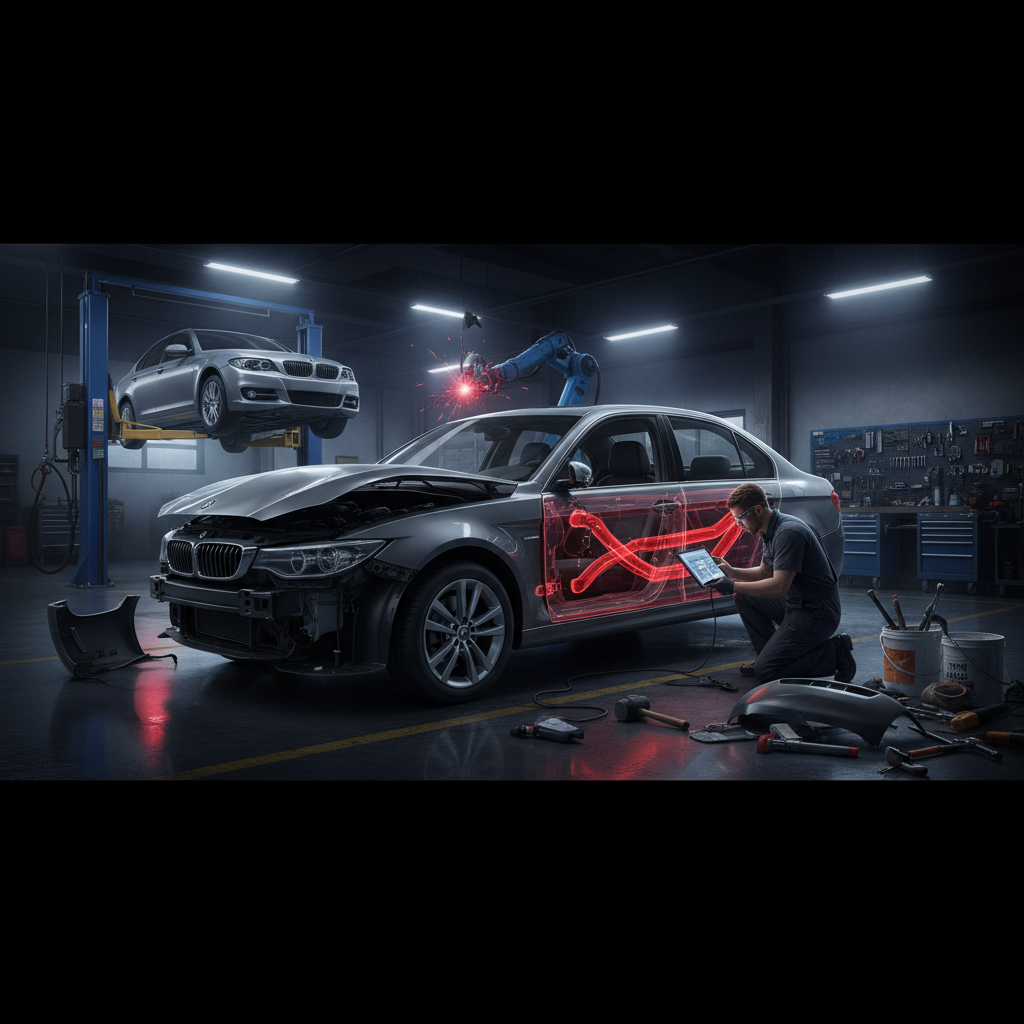
That is the first major signal in 7 Signs Your Car Needs Professional Body Work, Not a DIY Fix: the problem is no longer cosmetic. A dented bumper cover is one thing. A shifted hood, uneven panel gaps, a cracked support, or a door that no longer latches cleanly is something else entirely. Those symptoms can point to frame movement, alignment issues, or hidden damage beneath the surface.
How to spot structural or safety-related damage
Look for steering that pulls, wheels that sit off-center, warning lights after impact, or panels that rub when opened. If you notice those issues, the repair is likely beyond sanding, filler, or touch-up paint. A DIY repair may improve appearance, but it will not restore the original structure.
Why frame and alignment issues need a body shop
A body shop can measure the vehicle, identify hidden distortion, and repair it to factory standards. If the damage is affecting alignment, restraint systems, or the fit of surrounding panels, do not guess. Start with a professional inspection, and if you are comparing repair priorities, our What We Do page shows the kind of full-service work that goes beyond surface fixes.
2. Are the dents, creases, or bends too severe for basic tools?
If the metal is sharply folded, stretched, or kinked, basic tools will not bring it back to factory shape.
Key fact: A dent is not just a cosmetic mark, because dent depth, crease angle, and metal deformation determine whether a panel can be repaired safely or should be reshaped or replaced.
That is the turning point in 7 Signs Your Car Needs Professional Body Work, Not a DIY Fix. Light dents can sometimes be improved with simple methods, but once the damage creates a hard ridge, a sharp crease, or visible distortion along a body line, the panel has likely lost more than surface shape. Research on dent severity shows that depth and deformation are central to judging impact damage, not just the size of the visible mark, according to Dent Depth - an overview | ScienceDirect Topics and Methodology for Assessing the Effects of Plain Dents, Wrinkle Bends, and Mechanical Damage on Pipeline Integrity | Request PDF.
When simple dent removal stops being enough
If the damaged area springs back unevenly, ripples after repair attempts, or refuses to hold a smooth contour, the panel may need professional reshaping. In some cases, replacement is the better option than repeated pulling or filling.
Signs the panel needs professional reshaping or replacement
Watch for paint that cracks at the crease, edges that stay wavy, or a dent that sits on a seam or body line. Those details usually mean the issue is beyond a quick DIY fix. If you are comparing repair options, our What We Do page shows how a full body shop evaluates damage from inspection through structural repair, and our Gallery can help you see what finished professional work looks like.
3. Does the paint damage go beyond a surface scratch?
If the damage has broken through the clearcoat or base layer, it is more than a cosmetic scuff and should be treated as a professional repair.
Key fact: Once paint damage exposes the layers below the clearcoat, moisture, UV exposure, and contamination can accelerate deterioration, making refinishing more than a cosmetic choice.
When paint chips become corrosion risks
A tiny chip may look harmless at first, but exposed metal can start to oxidize and spread under the surrounding finish. In scratch-resistance research, automotive clearcoats are evaluated as protective systems, not just decorative finishes, because once that barrier is compromised, the surface loses part of its defense against wear and damage according to Fundamentals and characterizations of scratch resistance on automotive clearcoats - PMC. That is why the third of the 7 Signs Your Car Needs Professional Body Work, Not a DIY Fix is not just about how the scratch looks, but how deep it runs.
Why color matching and refinishing often require a pro
If the scratch has reached primer or metal, spot touch-ups can leave visible halos, mismatched gloss, or uneven texture. Professional refinishing is designed to blend color, restore protection, and make the repair durable enough to withstand real-world washing and weather. For a closer look at finished work, our Gallery shows how proper body repair and paint restoration should look when the job is done right.
4. Is the damage close to sensors, lights, or other safety components?
If the damage is near sensors, lights, or mounting points, the repair can be more complicated than it first appears.
Key fact: Modern bumpers and fenders often hide sensors, brackets, harnesses, and alignment points, so a small impact can affect both appearance and vehicle function.
That is where the fourth sign in 7 Signs Your Car Needs Professional Body Work, Not a DIY Fix starts to reveal a bigger issue. A cracked bumper cover or shifted panel may look manageable on the outside, but behind it could be a parking sensor, radar unit, headlamp assembly, or camera that needs precise repositioning. Even if the visible damage seems minor, compromised tabs, clips, or mounting surfaces can prevent components from sitting correctly.
Why bumper damage can hide bigger problems
Modern vehicles rely on accurate placement, and damage around these areas can trigger warning lights, reduce sensor accuracy, or leave gaps that invite moisture and road grime. In safety-sensitive zones, careful inspection matters more than a quick cosmetic patch. Research on damage-sensitive assessment shows that identifying the full extent of damage often depends on looking beyond the surface and checking how surrounding systems are affected, according to Conceptual damage-sensitive features for structural health monitoring: Laboratory and field demonstrations - ScienceDirect.
When electronics and mounting points need inspection
If the impact is close to lighting, driver-assist hardware, or structural attachment points, it is worth having a professional evaluate the repair. That kind of attention helps restore fit, function, and finish together, which is the difference between a temporary fix and a lasting result. For examples of completed work, our What We Do page shows the range of repairs and restorations we handle, while the Gallery gives a closer look at the quality you can expect.
5. Are there hidden issues like leaks, rattles, or new warning signs after impact?
If something starts leaking, rattling, or behaving differently after an impact, the repair likely goes deeper than the visible dent.
Key fact: New post-collision symptoms often point to shifted panels, loosened fasteners, or compromised seals, and those problems can worsen quickly if they are left untreated.
How to recognize damage you may not see at first glance
A bumper that looks fine can still hide a mounting issue, while a quarter panel that seems minor may have opened a path for water intrusion. Once moisture gets behind the finish, it can spread under the surface and accelerate corrosion, which turns a small repair into a larger one. That is why the 7 Signs Your Car Needs Professional Body Work, Not a DIY Fix includes anything that changes how the vehicle sounds, seals, or drives after the hit.
Listen for new rattles over bumps, check for damp carpet or fogged lights, and watch for gaps that were not there before. These are the kinds of clues that a quick patch can miss, but a professional inspection can catch before the damage grows. If you want to understand what a proper repair process looks like, our What We Do page outlines the services we use to restore body integrity, and the Gallery shows examples of finished work.
Why post-collision symptoms should not be ignored
Research also shows that incomplete or missed information can distort conclusions, which is a useful reminder here: the full story is not always visible at first glance, according to Concealing research outcomes: Missing data, negative results and missed publications - PMC. In repair work, the same logic applies, the symptom you notice today may be the clue to a larger issue underneath.
6. Would the repair likely cost more to redo than to do right the first time?
If the fix is likely to fail, the real cost is usually the second repair, not the first one.
Key fact: A cheap repair that has to be reopened, refinished, or corrected later often costs more overall than a proper repair completed once.
That is the turning point in 7 Signs Your Car Needs Professional Body Work, Not a DIY Fix. At this stage, the question is no longer whether you can make the damage look better for a weekend. It is whether the work will hold up after washing, weather, vibration, and daily use. Once materials, labor, and the risk of hidden damage are added up, the lowest upfront price can become the highest long-term expense.
This is why professional estimates matter. A trained technician can identify when panel preparation, corrosion control, or refinishing steps are essential to avoid repeat work. That kind of evaluation helps you compare the true repair path, not just the cheapest one. Consumer decision research also shows that cost strongly shapes repair choices, especially when people are trying to avoid unnecessary replacement, according to Cost Considerations Drive Consumer Repair Decisions - Innovation at Consumer Reports.
If you are weighing whether to invest in quality now or risk paying twice later, it helps to understand the scope of the repair first. Our What We Do page explains how we approach restoration and refinishing so the work is done to last.
When the smarter choice is the durable one
If the damage affects finish integrity, panel fit, or exposed metal, doing it right the first time usually protects the vehicle and your budget. That is the practical resolution: a professional repair is often the cheaper repair in the long run.
7. Do insurance, resale value, or documentation matter for this repair?
Yes, because the paper trail around a repair can matter almost as much as the repair itself.
Key fact: Complete repair documentation can help preserve more of your vehicle’s value, while missing records can reduce buyer confidence and lower resale offers.
Once you move from immediate damage to long-term ownership, the question shifts from “Can I fix this?” to “How will this repair be seen later?” That is where professional body work stands out. A documented repair shows the damage was handled correctly, which can matter when you file an insurance claim, negotiate a trade-in, or explain the car’s history to a future buyer. In fact, research cited by How Do Accidents Impact Your Car's Value? - Schaar & Silva notes that vehicles with complete repair histories can sell for 15% to 20% more than vehicles with missing paperwork.
That difference is why the answer in 7 Signs Your Car Needs Professional Body Work, Not a DIY Fix often includes more than visible damage. If the repair affects a large panel, paint blend, or structural area, proper documentation helps show the work was done to a professional standard. If you want to see how that kind of repair fits into a larger build plan, our What We Do page explains the restoration process, and Gallery | Our Custom Builds and Installs | Spade Kreations shows finished results.
Why documented repairs can protect resale value
A clean invoice, photos, and shop notes can reduce doubt and make the vehicle easier to resell, especially when the damage was significant enough that a DIY patch would have left questions behind.